THE 6 SCIATICA EXERCISES
I START MY SCIATICA PATIENTS ON
Stretching exercises work especially well when the cause of your sciatica is from a tight or spastic muscle.
PROCEED WITH CAUTION WITH THESE EXERCISES. If you do not know exactly which stretches and exercises to do, DO NOT do any. Guessing can hurt you and can make your sciatica worse. Talk to your doctor who is familiar with your current condition and health history before doing any of the exercises below.
If any of your sciatica symptoms get worse while doing any of these exercises, STOP.
If you develop new sciatica symptoms or new non-sciatica related symptoms while doing any of these exercises, STOP.
If your sciatica symptoms move farther away from your spine and/or farther down your butt, thigh, leg, or foot, STOP.
Sciatica symptoms can be relieved by low back exercises and stretches. However, if you are getting SHARP PAIN or worsening of your sciatica symptoms with any of the exercises below, your sciatica may be beyond this point. You may have a serious condition that needs expert help.
Sciatica Exercise #1: Contract your abdomen
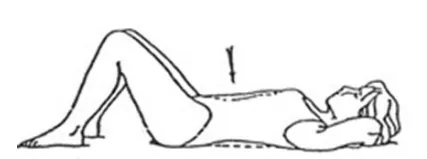
Tighten your abdomen by moving your belly button closer to your back.
You can do this exercise while sitting, standing, or lying down. This means that you can do this exercise while you wait in line at stores or while you are waiting for someone.
You can also tighten your abdomen while lying in bed, sitting in your car, or sitting at your desk.
Doing this simple exercise often can help strengthen your abdominal muscles, which can help relieve your sciatica. This can be safer for you than crunches or sit-ups.
You do not have to hold your abdomen in a contracted state for a long time. Just do this exercise consistently. As a bonus, you may notice your waist size getting smaller over time.
Sciatica Exercise #2: Bend your knee toward your
chest with your leg bent
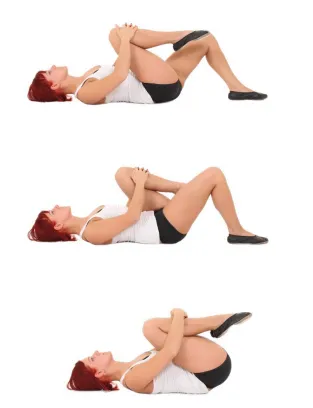
Lie face up, bend one leg up to your chest, then bring your leg back down. Do the same thing with your other leg. Then bend both legs at the same time, but only if you are able.
You can use your hands to help keep your knees bent, but do not use your hands to help you stretch farther. You may overstretch and injure yourself. Do not overdo this stretch, and do not hold your leg in the bent position too long.
Sciatica Exercise #3: Stretch your Piriformis (Method 1)
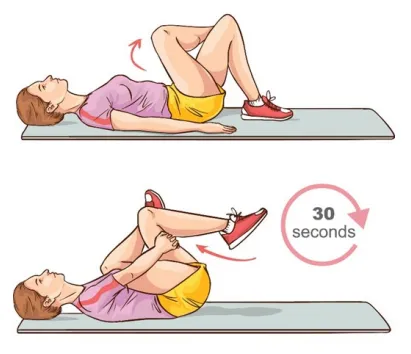
Put one leg over your opposite knee, then bend both legs towards your chest. You can wrap your hands around your top or bottom leg. Repeat with the other leg.
Sciatica Exercise #4: Stretch your Piriformis (Method 2)
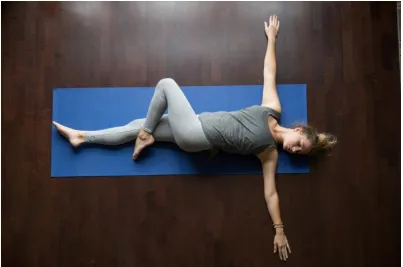
Lying face up, bend your knee toward your chest on the side of your sciatica. Gently twist the bent leg to the opposite side, which will rotate the lower back. Do not overstretch. Lay your bent leg on the floor, if you are able. Be sure BOTH of your shoulders are touching the ground.
You can choose the piriformis stretching exercise that works best for you, or you can do both methods. If you have very tight or spastic piriformis, you should feel your piriformis muscle get stretched when you do the two exercises above.
If you have a tight hip, you will feel it when you do sciatica exercise #4. If your hips are tight, you also need to loosen up your hip, since it may be complicating your sciatica. I usually give my patients specific exercises for a tight hip.
Sciatica Exercise #5: Hip Flexor Stretch/Gentle Lunge
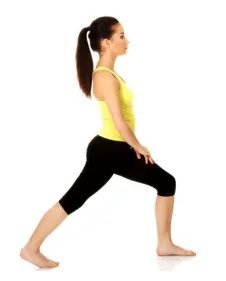
While standing, take a small step forward (about 12 inches). While keeping your back upright and straight and your tailbone tucked in, move your torso forward gently until you feel a gentle stretch in the front of the hip of the back leg. Repeat on the opposite side with the other leg in front.
Sciatica Exercise #6: Move and stretch your low back

While keeping your back straight, bend your back forward. Then backward. Then lean right. Then lean left. Then move your upper body to look over your right shoulder. Then move your upper body to look over your left shoulder.
Do these stretches CAREFULLY. Do not move your back quickly. Move it nice and slow. You
can stretch your back while sitting or while standing.
If your sciatica is caused by a herniated or bulged low back disc, you may find bending forward painful. If so, DO NOT bend forward.
You may also find bending to one side painful. If so, DO NOT bend to the side that is painful.
If your herniated disc or bulged disc is severe, you may not find a comfortable position. All positions and all movements may hurt.
If your sciatica is caused by a referred pain from an inflamed facet joint in your low back, you may find bending backward painful. If so, DO NOT bend backward.
Keep in mind that even if your pain or symptoms get worse when you bend backward, it is still possible that your sciatica may be caused by a herniated disc.
This can mean that in addition to your herniated low back disc, you may also have facet syndrome or facet arthritis complicating your sciatica. This is common, especially as we get older.
With the exercises and stretches that I discussed in this section, you are probably asking the following questions:
- How long should I hold each position?
- How many repetitions should I do?
- How many times a day should I do them?
- When should I do these exercises?
How long should you hold each position?
Start holding each position for 2-3 seconds. As you get stronger, you may be able to hold them longer, but DO NOT overdo it.
How many repetitions should you do?
Do as many as you can COMFORTABLY handle. Again, be careful not to overdo it. Start with 3-5 reps - less if you are not able to. Do more repetitions as you are able.
In sciatica exercise #1, contracting your abdomen, you should be able to do a lot of reps of this exercise compared to the other sciatica exercises.
When is the best time to do these sciatica exercises?
Do them at a time that works best for you. Also, when you start to feel your sciatica symptoms getting worse, stop what you are doing and do these sciatica exercises. This can help your keep your sciatica from getting much worse.
I understand that sometimes your back may start hurting at work where the floor is not clean enough to lie down on.
You can bring a yoga mat or a large towel to work or leave one in your car in case you need it. The mat you use doesn’t have to be fancy – you just need a clean surface.
Also, get a mat or towel with some cushion, especially if the floor at your work is hard like cement or hardwood. A cushioned mat will help make doing the sciatica exercises more comfortable.
DO NOT do these exercises for sciatica first thing in the morning. Your muscles and ligaments will not be warmed up, and you will be more prone to injury.

Do not do these sciatica exercises when you are exhausted. When you are extremely tired, your muscles and ligaments will have less strength to protect your joints if you overstretch.
How many times a day should you do these exercises for sciatica?
Twice a day works well for most people. It is better to do these exercises more often throughout the day, instead of overdoing them with excessive repetitions or by holding the positions too long.
After you do these sciatica exercises, you might feel sore in certain areas. Ice these sore areas and be sure to follow the icing instructions prescribed to you by your doctor who is familiar with your current condition and health history.